
Better proteins, in every round you run
Better proteins, in every round you run
Cradle connects protein design and optimization in one platform that learns from every assay.
Cradle connects protein design and optimization in one platform that learns from every assay.
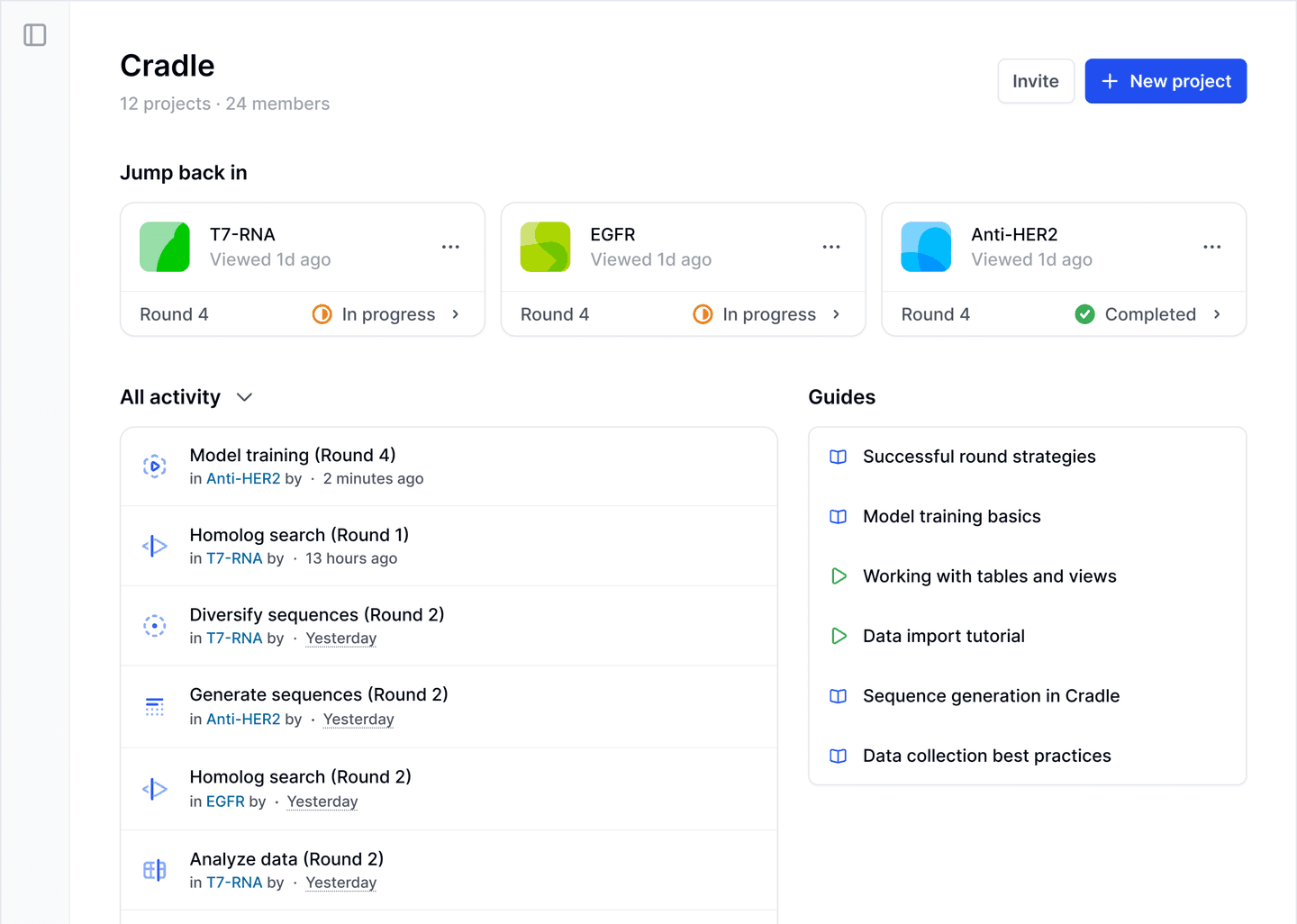

Make molecules you cannot make today.
Reach hard targets, complex modalities, and multi-property profiles that traditional protein engineering does not deliver.

Cut the cost and time of every R&D program.
Fewer wet-lab rounds, less human effort, less compute—the absolute cost of discovery and development drops.

De-risk your pipeline.
Higher activity, better developability, and stronger manufacturability raise the odds of success later in development.

Compound your R&D return.
Better molecules stay under patent longer with higher lifetime value, improving returns and justifying the next program.
From first design to final protein
Generate strong candidates and optimize them in one workflow. Each experiment builds on the last.
Guided rounds
Cradle guides you through each round’s set-up. From raw data to lab-ready candidates, best practices are built in, keeping outcomes consistent round over round.
Project-specific models
Use your assay data to train AI models on your protein’s individual fitness landscape. Cradle learns the specifics of each molecule and explores sequence spaces that traditional methods can’t reach.
Round forecasting
Score any candidate plate - including your own designs from other methods - against your trained model before committing lab spend. See the expected hit rate, the score distribution across every objective, and the headroom left in the round. Decide whether to run, redesign, or stop.
Reports & analytics
Cradle’s reports turn model outputs into clear data visualizations. Scientists determine how to proceed. Inspect variants, compare mutations, and get insights on what to test next.
Team collaboration
Cradle’s interface gives large research teams visibility across every project while remaining straightforward enough for smaller groups to run without overhead. Computational teams can engage with Cradle via our API.


Guided rounds
Cradle guides you through each round’s set-up. From raw data to lab-ready candidates, best practices are built in, keeping outcomes consistent round over round.
Project-specific models
Use your assay data to train AI models on your protein’s individual fitness landscape. Cradle learns the specifics of each molecule and explores sequence spaces that traditional methods can’t reach.
Round forecasting
Score any candidate plate - including your own designs from other methods - against your trained model before committing lab spend. See the expected hit rate, the score distribution across every objective, and the headroom left in the round. Decide whether to run, redesign, or stop.
Reports & analytics
Cradle’s reports turn model outputs into clear data visualizations. Scientists determine how to proceed. Inspect variants, compare mutations, and get insights on what to test next.
Team collaboration
Cradle’s interface gives large research teams visibility across every project while remaining straightforward enough for smaller groups to run without overhead. Computational teams can engage with Cradle via our API.
Two ways to work
with Cradle
Web application
Web application
An easy way for scientists to design and optimize proteins, no code required.
An easy way for scientists to design and optimize proteins, no code required.
API
API
Programmatic access to Cradle, built for advanced computational users.
Programmatic access to Cradle, built for advanced computational users.

Enterprise-grade security
Cradle is a protein engineering platform that is both ISO27001 and SOC2 Type II certified. Our platform runs on Google Cloud infrastructure, with strong technical controls, data isolation, and continuous monitoring. Customer data is always securely held and accessible only to those the customer authorizes.
Enterprise-grade security
Cradle is a protein engineering platform that is both ISO27001 and SOC2 Type II certified. Our platform runs on Google Cloud infrastructure, with strong technical controls, data isolation, and continuous monitoring. Customer data is always securely held and accessible only to those the customer authorizes.
Enterprise-grade security
Cradle is a protein engineering platform that is both ISO27001 and SOC2 Type II certified. Our platform runs on Google Cloud infrastructure, with strong technical controls, data isolation, and continuous monitoring. Customer data is always securely held and accessible only to those the customer authorizes.
Design and optimize better molecules, learning from every experiment along the way.
Optimize
Design
Learn
Optimize
Design
Learn
Reach your target profile across every property in fewer rounds.
Every property, optimized together.
Cradle optimizes all specified properties in parallel. Each round moves every axis in the right direction at once, so gains on one property are not lost when you push another. The result: better proteins in fewer rounds.
Reason over your Target Candidate Profile.
Set your desired profile as a primary objective plus constraints. Cradle manages the trade-offs, shows the probability of hitting each objective before you commit lab spend, and flags whether a target is unrealistic before you run the assay.
Bring your own design.
Rational and other traditional designs from your engineers sit alongside Cradle’s generations on every plate, get scored the same way, and become training signal for the model. Your team’s expertise carries into every subsequent round.
Find viable hits on hard targets from a single sequence.
Start from anywhere.
Start from a single sequence. Cradle can design a first round from it alone—no assay data required. Or start from a noisy screening pool such as NGS enrichment counts from a display or selection campaign. Cradle down-selects it to a diverse hit-confirmation plate.
Higher hit rate on hard targets.
Every plate is diverse by construction—spread across promising regions of sequence space, shaped by thousands of simulations. Cradle reaches where intuition and random screening cannot, so hits show up on targets where traditional methods stall.
Every sequence is lab-ready.
Constraints—fixed regions, liability motifs, length limits, and more—are applied at generation, not filtered afterward. Every sequence returned is buildable and compatible with whatever reformatting or conjugation comes next. No wasted wells on candidates you can’t actually make.
Every round makes the next one sharper.
Every assay makes the model smarter.
Upload results from a plate—Cradle’s generations, your rational designs, or a mix—and Cradle retrains for your molecule before the next round. Contrastive learning connects data across plates: no wasted signal due to batch effects.
Your project builds on Cradle’s proprietary data foundation.
Cradle’s AI models include: publicly available data, our own wet-lab data from the Amsterdam lab, and your own assay data. The result: every 2 weeks, your system gets smarter—even before you upload a new plate. (*We never train other customer models on your data. Learn more)
Decide the next round before you commit.
Score any candidate plate against your trained model in silico—expected hit rate, per-objective distribution, remaining headroom. See when to run, when to redesign, and when to stop, before you commit synthesis and assay spend.












Optimize
Design
Learn
Optimize
Design
Learn
Reach your target profile across every property in fewer rounds.
Every property, optimized together.
Cradle optimizes all specified properties in parallel. Each round moves every axis in the right direction at once, so gains on one property are not lost when you push another. The result: better proteins in fewer rounds.
Reason over your Target Candidate Profile.
Set your desired profile as a primary objective plus constraints. Cradle manages the trade-offs, shows the probability of hitting each objective before you commit lab spend, and flags whether a target is unrealistic before you run the assay.
Bring your own design.
Rational and other traditional designs from your engineers sit alongside Cradle’s generations on every plate, get scored the same way, and become training signal for the model. Your team’s expertise carries into every subsequent round.
Find viable hits on hard targets from a single sequence.
Start from anywhere.
Start from a single sequence. Cradle can design a first round from it alone—no assay data required. Or start from a noisy screening pool such as NGS enrichment counts from a display or selection campaign. Cradle down-selects it to a diverse hit-confirmation plate.
Higher hit rate on hard targets.
Every plate is diverse by construction—spread across promising regions of sequence space, shaped by thousands of simulations. Cradle reaches where intuition and random screening cannot, so hits show up on targets where traditional methods stall.
Every sequence is lab-ready.
Constraints—fixed regions, liability motifs, length limits, and more—are applied at generation, not filtered afterward. Every sequence returned is buildable and compatible with whatever reformatting or conjugation comes next. No wasted wells on candidates you can’t actually make.
Every round makes the next one sharper.
Every assay makes the model smarter.
Upload results from a plate—Cradle’s generations, your rational designs, or a mix—and Cradle retrains for your molecule before the next round. Contrastive learning connects data across plates: no wasted signal due to batch effects.
Your project builds on Cradle’s proprietary data foundation.
Cradle’s AI models include: publicly available data, our own wet-lab data from the Amsterdam lab, and your own assay data. The result: every 2 weeks, your system gets smarter—even before you upload a new plate. (*We never train other customer models on your data. Learn more)
Decide the next round before you commit.
Score any candidate plate against your trained model in silico—expected hit rate, per-objective distribution, remaining headroom. See when to run, when to redesign, and when to stop, before you commit synthesis and assay spend.
Optimize
Design
Learn
Optimize
Design
Learn
Reach your target profile across every property in fewer rounds.
Every property, optimized together.
Cradle optimizes all specified properties in parallel. Each round moves every axis in the right direction at once, so gains on one property are not lost when you push another. The result: better proteins in fewer rounds.
Reason over your Target Candidate Profile.
Set your desired profile as a primary objective plus constraints. Cradle manages the trade-offs, shows the probability of hitting each objective before you commit lab spend, and flags whether a target is unrealistic before you run the assay.
Bring your own design.
Rational and other traditional designs from your engineers sit alongside Cradle’s generations on every plate, get scored the same way, and become training signal for the model. Your team’s expertise carries into every subsequent round.
Find viable hits on hard targets from a single sequence.
Start from anywhere.
Start from a single sequence. Cradle can design a first round from it alone—no assay data required. Or start from a noisy screening pool such as NGS enrichment counts from a display or selection campaign. Cradle down-selects it to a diverse hit-confirmation plate.
Higher hit rate on hard targets.
Every plate is diverse by construction—spread across promising regions of sequence space, shaped by thousands of simulations. Cradle reaches where intuition and random screening cannot, so hits show up on targets where traditional methods stall.
Every sequence is lab-ready.
Constraints—fixed regions, liability motifs, length limits, and more—are applied at generation, not filtered afterward. Every sequence returned is buildable and compatible with whatever reformatting or conjugation comes next. No wasted wells on candidates you can’t actually make.
Every round makes the next one sharper.
Every assay makes the model smarter.
Upload results from a plate—Cradle’s generations, your rational designs, or a mix—and Cradle retrains for your molecule before the next round. Contrastive learning connects data across plates: no wasted signal due to batch effects.
Your project builds on Cradle’s proprietary data foundation.
Cradle’s AI models include: publicly available data, our own wet-lab data from the Amsterdam lab, and your own assay data. The result: every 2 weeks, your system gets smarter—even before you upload a new plate. (*We never train other customer models on your data. Learn more)
Decide the next round before you commit.
Score any candidate plate against your trained model in silico—expected hit rate, per-objective distribution, remaining headroom. See when to run, when to redesign, and when to stop, before you commit synthesis and assay spend.
“Cradle’s platform provides us with a scalable, scientist-centric solution to maximize the opportunities in our biologics portfolio and potentially deliver faster, more effective medicines to patients.”

Anastasia Hager, Ph.D.
Global Head of Drug Discovery Sciences, Bayer
“In vitro, or it didn’t happen.”
At Cradle, our algorithms and pipeline improvements are validated in vitro in our Amsterdam lab before they ship to customers. It’s the only way to build AI that scientists can trust. All your projects start with years of Cradle data, built in.




Follow Cradle
Sign up for our newsletter
Built with ❤️ in Amsterdam & Zurich
Follow Cradle
Sign up for our newsletter
Built with ❤️ in Amsterdam & Zurich
Follow Cradle
Sign up for our newsletter